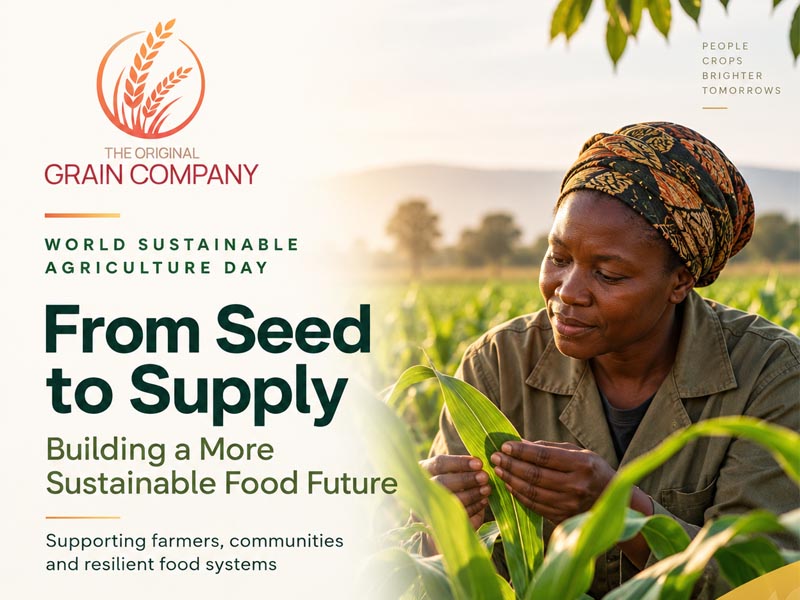

From Seed to Supply: Building a More Sustainable Food Future
World Sustainable Agriculture Day | September 2026
Sustainable agriculture is about far more than what happens on the farm. It is about creating the conditions that allow farmers, communities and food systems to remain productive and resilient for generations to come.
As World Sustainable Agriculture Day highlights the importance of sustainable farming and food security, it is also an opportunity to look beyond the field itself and consider what agriculture needs to thrive. At The Original Grain Company, we believe sustainable agriculture must be viewed across the entire agricultural value chain.
Farmers need access to capital, skills, technology, infrastructure and reliable markets. Rural communities need opportunities to build livelihoods around agriculture. Businesses, investors, donors and other stakeholders all have a role to play in supporting the systems that enable agriculture to become more productive, inclusive and resilient.
For us, sustainability is therefore not simply about producing a crop responsibly. It is about creating the conditions that allow farmers and agricultural communities to remain productive over the long term.
Bridging the agricultural funding gap
One of the biggest challenges facing farmers is the significant financial investment required long before a crop generates an income.
Seeds, fertiliser, labour, fuel, equipment and crop protection all need to be secured at the beginning of the production cycle. For many farmers, accessing the capital required to get a crop into the ground can be a major barrier.
Our Advanced Agricultural Product Purchasing (AAPP) programme, through The Original Grain Fund, was developed to help address this challenge. AAPP provides upfront investment based on the land being planted, while also helping to secure a route to market for the harvested crop through guaranteed offtake arrangements linked to SAFEX pricing.
We see this as more than simply funding a planting season. It is about helping farmers plan ahead, access the resources they need to produce a crop and have greater certainty about the market for what they produce.
That stability can have a direct impact on the resilience of the wider agricultural system.
The need for this type of support is particularly important in areas where agricultural land remains underutilised because of limited access to capital, technical expertise or operational support. When these barriers can be addressed through the right partnerships, underutilised land can become productive agricultural assets, while creating opportunities for rural economic participation.
Sustainable agriculture means sustainable communities
Agriculture's contribution to sustainability extends well beyond food production. In rural communities, agricultural development can support employment, skills development, local economic activity and longer-term livelihood opportunities.
This means agricultural investment is relevant not only to farmers, but also to businesses, donors and organisations looking for practical ways to contribute to food security and rural development.
Through The Original Grain NPC, we are complementing the broader agricultural ecosystem through community partnerships, practical training and agricultural development focused on building livelihoods and strengthening food security.
Our experience has reinforced an important principle: we cannot separate sustainable agriculture from sustainable communities. When people have access to skills, opportunities and the means to participate meaningfully in agriculture, the benefits can extend well beyond a single harvest.
The role of business in agricultural development
There is also an important role for the private sector to play. Corporates, donors and philanthropists can support initiatives that address practical challenges in rural communities, from agricultural skills development and training to infrastructure, innovation and productive land use.
The Mcambalala Maize Project in the Eastern Cape provides a practical example of what can happen when corporate, technical, community and market support come together around a shared agricultural goal.
The initial project supported white maize production across 50 hectares of communal land, involving 70 participating farmers. Its success has paved the way for a significant expansion, with the project increasing from 50 to 350 hectares for the next planting season.
At its full planned scale, the expanded project is expected to produce approximately 2,450 metric tonnes of maize, with an anticipated harvest value of around R10 million. The expansion will deepen community participation, strengthen local food production and create further economic opportunities across the region.
For us, the project demonstrates how coordinated support can help transform underutilised communal land into a commercially oriented agricultural enterprise, while creating opportunities for rural communities to participate more meaningfully in the agricultural economy. It also highlights the value of bringing different strengths together.
Funding, technical expertise, operational support, skills development, market access and offtake each represent an important link in the agricultural value chain. When these elements work together, agriculture can become a much stronger platform for food security, rural development and economic participation.
From seed to supply
Financing farmers, producing quality grain, moving agricultural commodities efficiently and strengthening the communities involved in agriculture are not separate activities. They are interconnected parts of the same food system.
At The Original Grain Company, our focus is on sourcing, trading and logistics for agricultural commodities across Africa. Through The Original Grain Fund, we support farmers through the AAPP programme, while our NPC creates opportunities for community partnerships, practical training and agricultural development.
Together, these elements reflect our belief that food security cannot be achieved by focusing on production alone.
Agriculture is an ecosystem. If we want to grow Africa’s food future, we need to support the farmer, the land, the community and the supply chain. Sustainable agriculture depends on all of these elements working together.
World Sustainable Agriculture Day gives us an opportunity to consider not only how we produce food today, but what is needed to ensure that we can continue producing it tomorrow.
For us, supporting agriculture today means helping to build the capacity, opportunity and resilience needed for a more sustainable food future.

World Sustainable Agriculture Day